
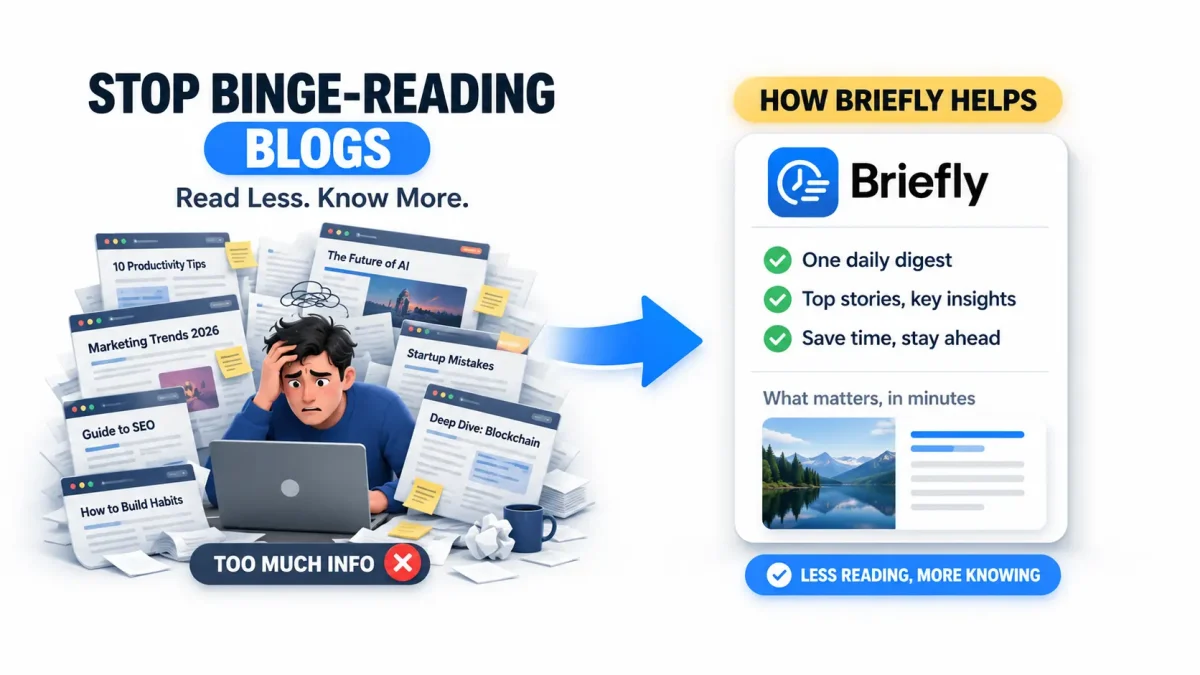
You opened one tab to check a single article. Ninety minutes later, you have 14 tabs open, three half-read Medium posts, a newsletter you “saved for later” two weeks ago, and you still haven’t gotten to the thing you actually needed to look up.
That’s blog binge-reading. It looks productive — you’re reading, after all, not scrolling reels — but it quietly eats the same hours that doom-scrolling does, just with better marketing.
Blog binge-reading is the compulsive habit of opening article after article — through related-post links, “you might also like” widgets, newsletter digests, and Slack shares — without ever finishing or acting on most of them. It’s driven by the same mechanics as video binge-watching: curiosity loops, fear of missing out, and content that’s optimized to keep you clicking rather than to get you to the point.
The difference is that blog reading feels like learning, so we rarely notice how much time it consumes until the tab count gets embarrassing.
1. Every post is written to be 2,000 words, whether it needs to be or not. SEO best practices reward long-form content, so even a simple idea gets padded with intros, anecdotes, and recaps before you reach the actual takeaway.
2. Newsletters and RSS feeds pile up faster than you can read them. If you follow more than a handful of blogs, newsletters, or Substacks, your inbox becomes a backlog, not a reading list — and backlogs create guilt, not knowledge.
3. “Just one more article” is a real cognitive trap. Related-post links are engineered to keep you reading. Each click feels small, but they compound into an hour you didn’t plan to spend.
4. You’re trying to stay current across too many topics. Founders, marketers, and consultants often need to track industry news, competitor blogs, and thought leadership across several niches at once — far more than anyone can actually read in full.
It’s not just lost time. Binge-reading also produces:
Skim only the headline and first line. If it’s not clearly relevant to something you’re working on this week, close it — don’t “save for later.”
Give yourself a fixed 15–20 minutes for blog reading per day. When a hard limit exists, you naturally filter for what matters instead of consuming everything available.
Checking five blogs five separate times a day guarantees binge-reading. Checking them once, in one sitting, doesn’t.
This is the biggest lever. Most blog posts have one to three core ideas buried inside padding, examples, and SEO filler. If something can pull out just those ideas, you don’t need to read the other 1,800 words at all.
Briefly was built for exactly this problem. Instead of manually opening, skimming, and half-finishing article after article, you point Briefly at the blogs, newsletters, and news topics you care about, and it does the reading for you.
Automatic monitoring. Add a blog, website, or news topic once, and Briefly keeps tracking it — no more manually checking five tabs a day or hunting through a cluttered inbox.
Key-idea extraction, not just shortening. Briefly doesn’t just chop a post down; it identifies the actual arguments, data points, and takeaways buried inside the padding, so a 12-minute article becomes a 45-second scan without losing the substance.
One daily digest instead of a dozen open tabs. All your tracked sources — blogs, YouTube channels, podcasts, and news — get consolidated into a single daily summary, so “catching up” becomes a five-minute habit instead of an open-ended scroll.
Read it or listen to it. Every summary can be converted to audio, so you can catch up on your blog backlog on a commute or a walk instead of squinting at a screen for another 20 minutes.
Available where you already are. Send a link to Briefly on WhatsApp or Telegram, or summarize whatever page you’re on with the Chrome extension — no need to change how or where you already browse.
You don’t need to read fewer things because you care less. You need to read fewer things in full because most of what’s valuable in a blog post is one or two ideas, not two thousand words. Briefly finds those ideas for you, delivers them daily, and lets you decide — quickly and deliberately — what’s worth a deeper read.
Stop letting your reading list read you. Start your free Briefly trial and turn your blog backlog into a five-minute daily digest.
